Life with a Pump and Faith in a Transplant
In 2011, I was getting ready for an exam. I was supposed to leave for Trstenik, where I was studying information technology at a two-year post-secondary school. That morning, I got up as usual, got ready for the trip, and then suddenly started coughing, and coughed up blood. I went straight to the emergency center. The tests showed that my lungs were fine, but that my heart was seriously enlarged and pressing against them. Later, the doctors found traces of the Coxsackie virus, which had weakened my heart.
Before that, I hadn’t had any symptoms at all. The only thing I had noticed was that I had been feeling tired for a few months, but I thought it was because of winter and being out of shape. I kept telling myself: ‘Spring will come, I’ll start exercising, and I’ll feel better.’ I had no idea that something much more serious was going on.
What followed were surgeries, examinations, and a fight that continues to this day. After a coronary angiography, the doctors tried to improve my heart function. The first operation was unsuccessful, but the second one worked, and that was when I received a pacemaker to monitor my heart. Even then, they told me openly that one day I would need a transplant. They could only slow down the deterioration of my heart, not restore it to what it had once been.
For the next three years, my heart kept functioning. At that time, only one or two heart transplants were being performed in Serbia each year. Then, in 2014, my condition suddenly began to get worse. I was short of breath, tired very easily, started coughing, and fluid began building up in my lungs. I also got an implanted defibrillator as protection in case my heart stopped. At the end of September that same year, I entered the transplant procedure. That was when Dr. Emilija Nestorović spoke with me and suggested implanting a mechanical heart pump so I could survive until a transplant became possible. I agreed.
I had surgery in October, but serious complications followed. I spent seven days in an induced coma. During that time, my heart stopped beating several times a day. My chest was left open so the doctors could directly resuscitate my heart every time it collapsed.
And yet, after that enormous battle, my heart began to recover. I woke up from the coma, and a long recovery began. There were more complications, more surgeries, and internal bleeding, but step by step, I managed to get back on my feet.
The pump improved my quality of life. All of a sudden, I could breathe more easily again, and I noticed that I had stopped coughing. I could drive, go for walks with my wife, and later with my son, who was born at the end of 2015. I was able to be there for him as he grew up.
Of course, nothing was simple. The cable that powers the pump comes out through my abdomen and requires daily dressing changes and sterile conditions. I couldn’t go to the pool, and even an ordinary shower was not easy. I carry with me all the equipment in a special leather pouch. At night, I am literally tied to the bed. During the day, I wear batteries that power the pump, and at night I have to connect to electricity through a module, because that is a much safer option while sleeping.
I was on the transplant waiting list from 2015 to 2018. I was called three times, but the matches with the donors were not good enough. During that period, my condition with the pump was stable, but sometimes other factors made the final decision.
Later, I developed an allergy to heparin, which meant I had to be temporarily removed from the transplant list. In December, it was confirmed that I no longer had the allergy, and since February of this year I have been active on the list again. But so far, I still haven’t received the call that could save my life and change it forever.
The support of the association Together for a New Life means a great deal to me, as does my friendship with Mladen Todić. We are there for one another - people with transplants, people living with pumps, and families going through the same struggles. We share experiences and advice, and we organize public panels to raise awareness about the importance of organ donation.
I also do my best to be there for others, to show people what life with a pump really looks like, to advise new patients, and to talk to those who are only just entering this fight. And those who have already gone through transplantation help me prepare for what lies ahead. We have become one big family.
Still, my greatest strength in all of this is my wife. She has been by my side since 2008. She has never given up on me, not even in the hardest moments. She has gone through every fear with me, every surgery, every hospital stay. She visited me in the hospital even while I was in a coma. For years, she has helped me with the daily dressing changes. All these years, we have been in this together.
And then there are our sons. Our older son is ten, and the younger one is two. Last summer, we managed to take them to the seaside during the period when I was temporarily off the transplant list. I couldn’t swim. I could just stand in the shallow water and wet my feet, but I was happy that we were able to take them to the sea.
We keep pushing forward together through all of this.
AUTHOR
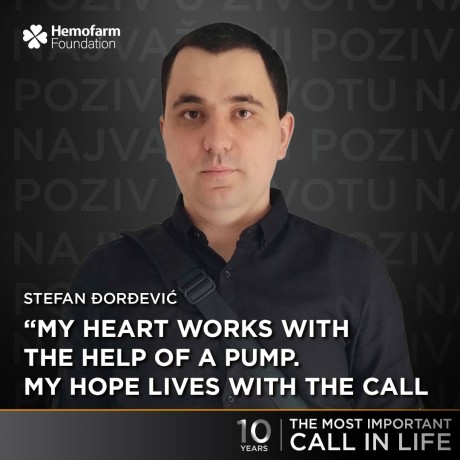
Stefan Đorđević