How are you today?
What happens to us when we spend a long, long time under pressure, living with uncertainty and apprehension about what tomorrow might bring, moving between feelings of hopelessness and helplessness? And then, after so many unsuccessful attempts, disappointments and moments of faltering hope, something shifts. Change has happened. Something that once seemed almost impossible has become real. How do we feel then? How do we respond? Joy and disbelief overwhelm us at the same time. We laugh and cry, hug and sing, dance with happiness, while somewhere underneath it all, apprehension lingers. What is happening to us? Why does our vigilance not automatically disappear after prolonged stress, and why is it so difficult to relax and let ourselves feel joy?
To understand how we feel now, we need to understand how we were living—or, more accurately, surviving—until that moment. When a wider community experiences events that undermine its fundamental sense of safety, trust, cohesion and order, this constitutes social or collective trauma. It can result not only from major natural disasters, wars and mass violence, but also from prolonged institutional injustice, economic crises and political repression. These erode social ties, mutual trust and solidarity, while feelings of helplessness and insecurity threaten mental health and contribute to increased anxiety, depressive symptoms and stress.
After such prolonged stress, the body and mind cannot simply “switch off” the alarm system that has kept them alive. The main reason we struggle to relax and feel joy is that our bodies remain “stuck” in a state of chronically heightened stress. Even when we consciously know that the danger has passed, our bodies remain on alert as though it were still present. Accustomed to signals of threat, the brain has more difficulty processing positive signals from our surroundings, making it harder to take in good moments. Even when we do things we love, the brain struggles to produce that chemical “surge” of joy.
When we have spent a long time in survival mode, we retain an emotional “shield” against vulnerability. Relaxing can feel dangerous, as though it would leave us unprepared if something bad happened. We deny ourselves joy because the belief persists that something good must immediately be followed by something bad. When the body exhausts its defensive resources, it enters a state of exhaustion. Emotional numbness often follows, acting as a protective mechanism to prevent further energy expenditure.
How is it possible to feel happiness, relief, fear and uncertainty at the same time?
Experiencing conflicting emotions simultaneously is not only possible; it is a natural response to major life changes or the end of a difficult period. The phenomenon of “mixed emotions” arises because the brain and body process a situation on different levels.
Feeling relief and tension at the same time reflects a conflict between body and mind. Relief comes from knowing that a threat has passed or that something good has happened. Tension remains because the body cannot suddenly “reset” itself.
Conflicting feelings of joy and apprehension reflect the mind’s simultaneous focus on the present and the future. Joy is a response to success or good news: we celebrate what is happening now. Apprehension, meanwhile, is the response of a mind looking ahead. While we feel joy, a defensive mechanism asks: “What if this doesn’t last? What if this is just the calm before the storm? Could I cope if things went wrong again?”
The more something matters to us, and the more joy it brings, the greater our fear of losing that feeling. This emotional cocktail most often arises at turning points when, after prolonged struggle, suffering or uncertainty, a threat ends because success has been achieved.
It is important to accept this confusing state as a normal transitional period of gradual recovery. We need to allow ourselves this “roller coaster” and give our bodies time to release the remaining stress, knowing that we are now safe.
Does prolonged uncertainty change our expectations of life and our ability to believe that things can be different?
Prolonged uncertainty profoundly changes how we experience life and directly affects how we think. In a state of sustained insecurity, the brain operates in survival mode, altering our perception of reality, our thinking and our decision-making.
Mental fatigue develops because the brain treats uncertainty as a problem that constantly needs solving. When no solution is in sight, it keeps running different scenarios in the background. This consumes enormous amounts of mental energy, leaving us less able to focus on everyday tasks and contributing to memory difficulties and a sense of “brain fog.”
Prolonged insecurity pushes us to live from one day to the next. Our decisions become reactive rather than proactive. Under the pressure of uncertainty, we try to protect ourselves from potential disappointment by viewing unlikely negative scenarios as almost inevitable. It seems safer not to believe in change than to risk disappointment again. Disbelief in a better future becomes a kind of shield. Cynicism becomes the only “realistic” outlook, while hope is equated with naivety.
Without firm facts to rely on, we tend to overanalyze every option, often delaying decisions or becoming unable to act at all. We begin to feel that we are no longer in control of our own lives. The experience of finding that our efforts do not guarantee a predictable, positive outcome leads to “learned helplessness”: we stop trying because we believe our actions make no difference to the result. Even when genuine opportunities for a positive turning point arise, we dismiss the possibility of change as unrealistic.
Living with uncertainty makes the world seem less safe, so even neutral situations can be interpreted as threatening. Emotional numbness, in which we feel neither sadness nor joy, acts as protection against constant heightened arousal. At the same time, difficulties regulating emotions can mean that even the smallest frustration triggers an intense reaction.
Over time, prolonged uncertainty deeply undermines our ability to believe that things could ever be different, better or more stable. In psychology, this phenomenon is called the erosion of optimism: the current situation comes to be seen as the only possible, permanent reality. In survival mode, the mind has no “luxury” of imagining better days. It clings to what exists now because anything new represents too great a risk.
Becoming accustomed to “constant crisis” makes us forget what it feels like to live in a predictable, safe environment. The idea of a stable, different life begins to seem abstract and unfamiliar, while constant tension and anticipation become our “new normal.”
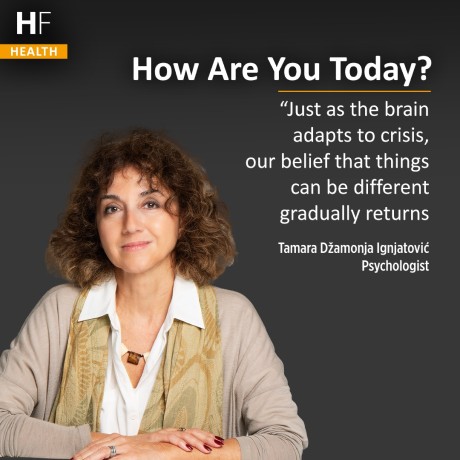
Just as the brain adapts to crisis, our belief that things can be different gradually returns. It does not return all at once, but through “micro-changes”—a change in routine, improving our surroundings or a thorough clean-up—that offer small pieces of evidence that change is possible and that we can shape it.
Rather than waiting for the entire situation to change, it is important to focus on what we can do from day to day. An attitude of “cautious hope” leaves the door slightly open to a positive outcome: the possibility that things can get better.
How do we rebuild trust in people, processes and institutions?
Rebuilding trust after prolonged stress and trauma does not happen suddenly or through willpower alone. It is a gradual process in which the mind and body relearn that the world is not exclusively a dangerous place.
Betrayal by the system creates a particular kind of powerlessness because we are confronted with an impersonal, powerful apparatus. Recovery therefore cannot be viewed solely as an individual process. It also requires social renewal, justice and the restoration of trust.
But rebuilding trust in institutions after systemic trauma does not mean trusting the system blindly. Institutions are made up of individuals. Within them, there are professionals—doctors, judges and public officials—who do their jobs conscientiously and represent individual “islands of safety.”
Trust is easier to build when we have someone alongside us who understands the system and the “rules of the game,” such as civic associations or informal support groups whose members share similar experiences. They act as a shield between the individual and the system.
A detailed understanding of our rights, procedures, legislation and avenues for complaint reduces uncertainty. The groups we belong to provide information and support, both essential to moving from the role of victim to that of an active participant in rebuilding institutions. Through this process, trust is gradually restored.
Can the collective joy we see today—in hugs, tears and a sense of togetherness—be part of society’s psychological recovery?
Collective joy, togetherness and the widespread sharing of emotions in the streets act as a form of “group therapy” directed towards post-traumatic growth. What we are witnessing in the tears, hugs and overwhelming energy on the streets is more than a passing reaction. It is a deep, instinctive process of collective healing.
Gathering together and sharing the same emotion brings people into sync, dissolves the boundaries between individuals and creates a sense of something greater and stronger than ourselves. This kind of collective action contributes to the post-traumatic growth of the whole community.
Above all, it offers a way out of isolation, because trauma isolates people. When people take to the streets and see thousands of others crying, hugging or cheering for the same reason, that isolation breaks. Seeing that pain is shared makes it easier to bear.
Hugging, chanting and singing together trigger the release of hormones associated with happiness and connection. This biological cocktail acts as a brake on the trauma alarm, while our nervous systems regulate themselves through the strength of the group in a process of co-regulation.
Where trauma makes us feel helpless, collective action in the streets restores a sense of control. People once again feel that their voices and their presence matter—a direct antidote to “learned helplessness.”
Together, these processes lead towards post-traumatic growth, which is never simply a return to the way things were. It means developing a new, more resilient version of ourselves and our society after a crisis.
Collective joy and solidarity encourage growth by revealing a community’s strength: we discover that, together, we are more capable, united and supportive than we had thought. This also allows deeper connections to develop. Relationships become more authentic, while superficial differences fade in the face of a shared goal or shared emotions.
The collective narrative changes too. Instead of a story of victimhood and defeat, the community begins to create a new narrative of success, solidarity and resistance, restoring pride and a sense of individual and collective worth in place of shame, humiliation and inadequacy.
Although collective joy is healing, it also demands enormous energy. Scenes of togetherness in the streets carry tremendous power. But when the lights go out and people return home, it is normal to experience a sudden drop in energy, emptiness or sadness. This does not mean the process has failed. It means the body needs rest to integrate what it has experienced.
Renewed growth begins in the streets, but takes root in the days that follow, as we sustain these new connections and practice solidarity in everyday life.
AUTHOR
Tamara Džamonja Ignjatović
psychologist