No One Dances Alone in Kolo
From seventeen years on stage to taking their first steps in their fifties: four colleagues from Hemofarm talk about how folk dancing connects them with others, preserves tradition and helps them find time for themselves.
One outstretched hand is enough for someone to join the kolo. Then comes another, and a third. Steps fall into sync, and individual movements become part of a shared rhythm. This simple image holds what may be the most important reason folk dance endures across generations: the feeling of belonging to something greater than ourselves.
For
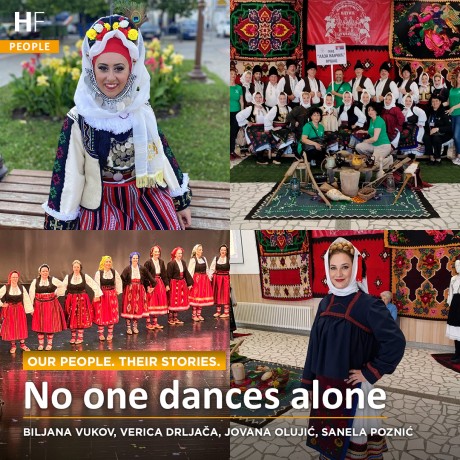
Jovana Olujić, Sanela Poznić, Biljana Vukov and Verica Drljača, colleagues at Hemofarm, folk dancing is much more than a way to stay physically active. It is part of growing up, an opportunity to socialise, a family legacy or a new beginning. The four are connected through the “Laza Nančić” Cultural and Artistic Society in Vršac, where more than fifteen Hemofarm employees dance in various ensembles and groups.
Although their stories differ, they all speak of things that are easy to lose in everyday life: time for ourselves, closeness with others and the pleasure that movement brings.
Jovana Olujić grew up with folk dancing. She has been dancing for seventeen years and is now a member of the main performing ensemble. Behind every performance, she says, are years of learning, repetition and perseverance.
“My journey from the youngest children’s group, through the children’s and preparatory ensembles, to the performing ensemble has made me a persistent, determined person, ready to keep improving and give my best.”
Today, spending much of her working day at a computer, she finds a change of pace at rehearsals. Instead of screens and work tasks, music, movement and the people around her take over her attention.
“After a demanding day at work, I can hardly wait to go to rehearsal, clear my mind through song and dance, and recharge my batteries for the next working day. Physical activity is very important to me because my job requires me to spend a lot of time sitting in front of a computer.”
Sanela Poznić has been folk dancing for ten years. She is a member of the recreational group, and what brings her back to rehearsals is not only her love of dancing but also the feeling she takes home with her.
“What motivates me is knowing that, no matter what kind of day I’ve had, I’ll leave rehearsal smiling, feeling lighter and full of positive energy.”
Folk dancing has brought her better fitness, greater assurance in her movements, friendships and self-confidence. Yet the moments she remembers most are those when she stops thinking about the choreography. Once all the steps have been practised, individual effort gives way to dancing together.
“That is the moment when you stop thinking about the steps, when we all have smiles on our faces, the moment when the nerves disappear.”
Biljana Vukov has the longest connection with folk dancing. She has been dancing, with breaks, for thirty-seven years. Shift work means she cannot always attend rehearsals, but she makes an effort to remain part of the group.
For her, folk dancing has never been just a passing interest.
“Folk dancing isn’t an ordinary hobby that you quickly grow tired of. It is much more than that. It is part of our tradition and culture and contributes to personal learning and the development of our body and spirit.”
That connection with tradition has taken on special meaning within her family. She has passed her love of folk dance on to her daughters.
“What means the most to me is that I have passed my love of folk dancing on to my two daughters, who have also been members of the ‘Laza Nančić’ Cultural and Artistic Society for many years.”
For Biljana, kolo thus connects not only the people dancing together today but also the generations to come.
Unlike Biljana and Jovana, whose lives have been shaped by folk dancing for many years, Verica Drljača fulfilled her long-held wish only last year, in her fifty-second year.
Music was already familiar to her. She had sung in a choir, but her wish to take up folk dancing had remained unfulfilled for years. The decision came after a difficult period in her life.
“After a very stressful and sad period, I realised I needed something to turn my thoughts in a more positive direction.”
The first steps were not easy. She had to master new movements, find her place in the group and embrace the challenge of learning something unfamiliar. But it was precisely this process that brought her what she had been looking for.
“However demanding it may be, I can honestly say that it has helped me feel better in my own skin, experience positive energy again and feel that I belong to such a diverse yet united team.”
Verica’s story reminds us of something easily forgotten: new beginnings do not require us to wait for ideal circumstances. Sometimes, all it takes is deciding to take the first step.
Kolo was inscribed on UNESCO’s Representative List of the Intangible Cultural Heritage of Humanity in 2017. But its value is preserved in more than cultural registers and stage performances. It also lives in rehearsal halls, in encounters between people of different generations and in every new member who learns their first steps.
For these four colleagues, folk dancing is physical activity, a break from responsibilities and a space to connect with others. Learning the steps requires concentration and perseverance, while dancing together calls for attentiveness, adaptability and trust.
“We arrive at the folk dance hall at different points in our day: after work, between shifts, once we have taken care of family responsibilities. Sometimes tired, sometimes preoccupied with something we haven’t managed to leave behind at work. Folk dancing also teaches us to pay attention to others. In kolo, every step affects the next, so it is important to listen to the music, follow the group and adapt. The patience, responsibility and sense of teamwork we develop there stay with us outside the hall too,” the colleagues explain.
For some, folk dancing shaped their childhood. For others, it brought friendships; for some the chance to share the same passion with their children; and for others, it helped them begin a new chapter in life.
Different reasons, different paths through life. And something that connects them: when the music starts, each brings her own story, but none of them dances alone.
AUTHOR
Jovana Olujić, Sanela Poznić, Biljana Vukov i Verica Drljača