There is Room for Everyone in this City
Every morning, almost the same scene unfolds in Belgrade. Endless lines of cars, frustrated drivers, buses full of people running late, pedestrians waiting for the green light, and the occasional cyclist trying to find a place among them all. Everyone is in a hurry. Everyone has a reason to reach their destination as quickly as possible. And yet, it seems that no one ever gets there fast enough.
In this daily competition for a few minutes, a little space, and the right of way at an intersection, we have lost something far more important than time. We have lost the sense that the city belongs to all of us.
For fifteen years, since Critical Mass began in Belgrade, we have been trying to change precisely that. We started with bicycles, but over time we realised that our struggle was never just about cyclists. Above all, it is a struggle for solidarity, because the way we move through the city says a great deal about the way we live alongside one another.
When the Car Became More Important than the Person
Critical Mass is part of an international movement that brings together cyclists in more than 300 cities around the world. In Belgrade, it began in 2011 with a simple idea: to show that cyclists exist, that they have an equal right to use the streets, and that cities cannot continue to develop indefinitely by making more and more room for cars.
At first, we talked about the lack of cycle lanes, unsafe intersections, pollution, and climate change. We talked about how a transportation system based on the ever-increasing number of private cars is unsustainable in the long term.
We still talk about all these things today. However, the fifteen years of activism have taught us something else: none of these problems can be solved if everyone looks at the city solely from their own perspective.
Just look at the morning rush hour. Most cars carry one person, sometimes two, rarely more. At the same time, buses, trams, and trolleybuses carry far more people while taking up considerably less space per passenger. Yet, they all sit in the same traffic jams.
Someone who has chosen to use public transport instead of their own car gains no advantage from that choice. On the contrary, they are often equally penalised by having to wait.
Pedestrians do not fare much better. At intersections, they increasingly have to press a button to be allowed to cross the road. In the cold, in the rain, or in temperatures of forty degrees Celsius, they wait while lines of cars pass by.
And cyclists? They are still a rare sight in Belgrade. More experienced cyclists manage to weave through the traffic, sometimes even with a smile. However, many people who would like to cycle to work, university, or school never dare to do so. Not because they do not like cycling, but because they do not feel safe.
The problem, therefore, is not merely a lack of infrastructure. The problem is also that we have accepted the idea that the street is a place where everyone must fight for themselves.
Solidarity Begins at the Intersection
When we talk about solidarity, we usually think of helping people in need, humanitarian initiatives, or major social crises. We rarely think about traffic.
Yet, it is precisely there, that we have an opportunity to show how much we care about others every day.
Solidarity means giving way to a pedestrian, leaving enough room for a cyclist, or allowing a bus to merge into traffic. It also means deciding to leave the car at home because we know that doing so will leave more room on the streets for those who truly need it.
For ambulances. For people who use their cars for work. For families transporting relatives with limited mobility. For everyone who has no alternative means of getting around.
That is why I believe a city should encourage those who choose to walk, cycle, or use public transport. Not because their choices are morally superior, but because they benefit everyone.
Fewer cars mean less congestion, less pollution, less noise, and more space for living. And more rational use of cars also means greater freedom of movement for those who cannot do without them.
There is another reason why change is necessary, one that goes beyond all debates about traffic: safety.
We all have someone we worry about. A child crossing the street alone. An elderly parent who moves more slowly. A friend with a disability. A neighbour pushing a pram.
When we look at traffic through their eyes, the question is no longer how quickly a car can travel through the city. The question is how safely a person can live in it.
Reducing speed on city streets is not merely a traffic measure. It is a decision to place human life above a few minutes saved. It is also a way to reduce the stress experienced daily by everyone using the roads.
Cycling Reconnects Us with the City and with One Another
There is something that is often forgotten in discussions about cycling. A bicycle is not merely a means of transport. It changes our relationship with space, with people, and even with our own bodies.
When we drive, we often experience the city through a windscreen. We move from one point to another, generally focused on traffic, traffic lights, and the search for parking.
On a bicycle, the experience is different.
We notice people in the streets, shop windows, trees, parks, and places we would otherwise pass without paying attention. It is easier to stop for a coffee, have a conversation with someone we know, or pop into a nearby shop. The city ceases to be an obstacle to overcome and once again becomes a space in which we participate.
This is how those small, seemingly insignificant connections that build a community are formed. A greeting exchanged with a neighbour. A brief conversation. An unexpected encounter.
At a time when we increasingly talk about loneliness, alienation, and the loss of human connection, the value of these everyday encounters should not be underestimated.
Cycling has another valuable quality: it brings physical activity back into everyday life without requiring us to set aside additional time for it.
Regular physical activity contributes to cardiovascular health, physical fitness, and mental health. Cycling can help reduce stress and improve mood. In a country where cardiovascular diseases are among the leading health problems, such a change in everyday routines could be highly significant.
Research shows that active commuting can contribute to employees' health and psychological well-being and is also associated with lower rates of absence from work. But perhaps the most important thing is what many of us feel after a ride: that we return home feeling less burdened than when we set out.
It is particularly important that we provide this freedom to children.
A child who walks or cycles does not merely develop motor skills. They become familiar with their surroundings, learn to assess space, become more independent, and develop a habit of physical activity that can stay with them throughout their lives.
Imagine a Belgrade where parents do not have to worry when their children go to school. Where taking a child to a kindergarten is not another car journey through traffic, but a walk together. Where a child can learn to ride a bicycle and continue using it into adulthood.
Such a city would not only be healthier. It would also be happier.
Cities Do Not Change on Their Own
Over fifteen years, we have learned that good intentions are not enough. We need safe cycle lanes, connected routes, better public transport, and traffic solutions that prioritise people rather than cars.
But we also need a change in the way we think.
When discussing the future of cycling, Amsterdam, Copenhagen, and other European cities that have decided to organise their streets differently are often mentioned. Their experiences matter because they demonstrate that change is possible. However, simply adopting an infrastructure solution is not enough. We must understand why we are introducing it and whom it is intended to serve.
Belgrade does not need a cycle lane that ends precisely where it is needed most. It needs a connected network that makes cycling a genuine option for everyday travel.
Today, we are also advocating for better bicycle parking facilities, safer overtaking, and traffic regulations that recognise the needs of vulnerable road users. During 2026, an important step forward was taken with the adoption of standards for bicycle parking in new and renovated buildings in Belgrade.
These are steps in the right direction, but there is still much work ahead of us.
Change must become part of public policy, urban planning, and the conversations we have with citizens. The benefits of walking, cycling, and public transport need to be communicated clearly, persistently, and by those in the most responsible positions in society.
Nevertheless, no decision and no new cycle lane will, in themselves, create solidarity. We must build it ourselves, every day, through the way we treat one another.
The City We Leave to Our Children
When I look at the people who join Critical Mass today, I see much more than cyclists. I see parents with children, young people, older fellow-citizens, and people from different professions and walks of life. Some have been coming for years, others are there for the first time. Some cycle every day, others only occasionally.
But when we set off together, we all become part of the same idea.
Over the years, Critical Mass has grown beyond its original struggle for cyclists' rights. It has become a place where we demonstrate what a city could look like if we paid more attention to one another.
For me, that is its greatest value.
I do not envision Belgrade's future as a city with streets without cars, but as a city where the car is not the only option. A city where we can reach our destinations without putting someone else at risk. A city where a child has the right to a safe street, an older person to cross an intersection in peace, and a cyclist to a space where they would not have to prove their courage.
After fifteen years on the streets of Belgrade, I believe that change begins when we stop asking what is best only for ourselves and start thinking about what is better for everyone.
Join us – on the last Saturday of every month, we set off from Republic Square for a ride through the streets of Belgrade!
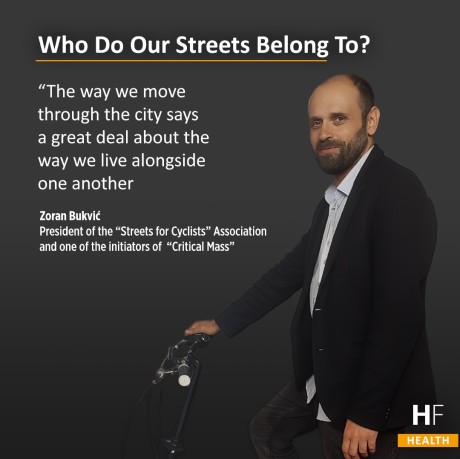
AUTHOR
Zoran Bukvić
President of the “Streets for Cyclists” Association and one of the initiators of “Critical Mass”