
23/11/2026
Kindness – What a Beautiful and Dignified Word!
Zora Krnjaić
Psychologist
Kindness – What a Beautiful and Dignified Word!
What lies at the very essence of being human, and what defines our humanity? Where does kindness reside, and why does it sometimes seem to retreat, as though it were weak, powerless or even unnecessary, making room for evil? Both kindness and evil are part of our human nature and experience. Yet what is distinctively human is culture and creativity: our ability to transform ourselves and the world around us, and to create. Culture stands in contrast to the primitive, and our humanity is affirmed precisely through the process of cultivating ourselves and the world in which we live.
A valuable theoretical framework for understanding the interconnected development of individuals, culture and society is provided by Lev Semyonovich Vygotsky’s cultural-historical theory. This theory explains how individual development takes place within a broader sociocultural and historical context through the internalisation of culture, and how culture itself represents the externalisation of the developmental achievements of previous generations. It is therefore not enough to call on individuals to be kind if the social environment rewards selfishness, violence, manipulation and dishonesty. We must build institutions, educational systems, media and communities that systematically encourage and recognise humanity, dignity and responsibility.
Human beings develop through interaction with others and with various products of culture which, like scaffolding, support and enable the construction of knowledge, skills, attitudes and values, as well as the formation of personality as a whole. Art, as a distinctive cultural system, serves as a cultural support system for emotional life and emotional development. Through symbols and symbolic systems, language above all, we enter a cultural space shaped by previous generations. This is why kindness is not merely a question of individual character, but also a question of experience and the culture of relationships we create within our communities.
Cultural development can be understood as an ongoing process and a continuous effort to transform the primitive into the cultivated, the inhumane into the humane, and the potential for good into goodness made real, both within ourselves and in others. In this process of imagining alternative realities and creating a better world, the human capacity for symbolic thought, self-regulation and creativity comes into play, all brought together in the kindness demonstrated by our young people.
In a creative, genuinely authentic and dignified way, young people have stood up for the opportunity to build a better and fairer society. They have demonstrated kindness, the ability to cooperate, solidarity and intergenerational connection. Their initiative reminds us that social change is not only a demand for different institutions, but also a call for different relationships between people. This places an obligation on us to do everything we can to create a better and fairer society. What matters is not only our willingness to help others, but also our ability to use our skills, talents, potential and achievements to improve the lives of others and the community to which we belong.
How Can We Help Kindness Grow?
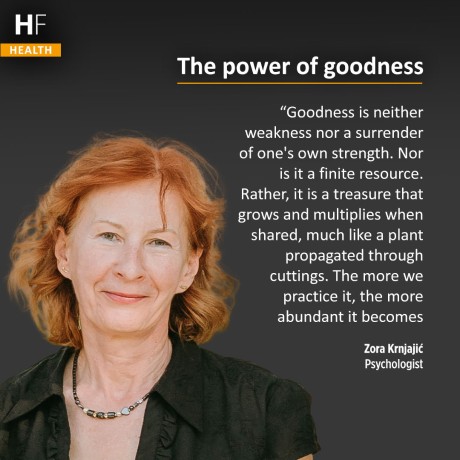
Let us not forget that kindness needs to be nurtured, that its value must be recognised and appreciated in everyone, especially in children and young people. Kindness is neither a weakness nor a renunciation of one's own strength. Nor is it a finite resource. Rather, it is a treasure that spreads and multiplies when shared, much like a flower cutting that takes root and grows. The more we practise it, the more of it there is.
Kindness becomes a source of strength for society when the relationships we build begin to reflect the values of kindness, dignity, freedom, solidarity and responsibility. That is why it is important to encourage and empower young people to use their abilities not solely to achieve personal goals, but also to create the common good. This involves developing the ability to understand different perspectives, recognise both our own interests and those of others, and make decisions with their broader and long-term consequences in mind.
A fulfilling and meaningful life requires us to strike a balance between our personal needs and goals, on the one hand, and the needs and interests of other people and the community, on the other. This does not mean sacrificing individuality for the sake of the collective, nor neglecting the common good in pursuit of personal success. On the contrary, it means understanding how the two are interdependent and how personal development and the well-being of the community can encourage and strengthen one another. Knowledge, creativity and exceptional abilities only realise their full value when combined with empathy, responsibility, solidarity and care for others.
Kindness is much more than an individual act of courtesy, a good deed or an act of help – it is a profound life philosophy and an ethical orientation towards other people and the community.
AUTHOR
Zora Krnjaić
Psychologist