
29/04/2026
Cycling as an Anti-Stress Therapy
Goran Manić
Associate for activities coordination, Corporate Affairs and Communication Department, Hemofarm Group
Cycling as an Anti-Stress Therapy
1. When and how did your love for cycling begin?
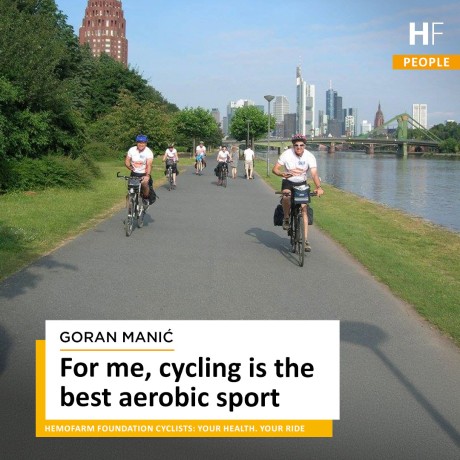
I started riding a bike as a kid. I grew up by the Danube, and it was a natural environment for cycling. Already in high school, I used to ride from Smederevo to nearby places, to the Danube for swimming, to Kovin. We always carried a bag because it’s a fruit-growing region and there was fruit everywhere. We would ride and pick fruit along the way, those are the images of my childhood on a bike. That’s how I got “hooked”. For me, cycling is the best aerobic sport, it expands lung capacity, develops the legs, arms and back, and strengthens the entire body.
2. What does cycling mean to you today, and what does your routine look like?
For me, it is both rest and anti-stress therapy. No matter how tired I am, a ride lifts me up. Once you get „hooked“, there’s no going back, my bike is more expensive than my car. I’m on the road at least three times a week because I’m a road cyclist, it’s part of my identity. I also taught my daughter to ride. When she was little, I used to carry her in a bike seat and that’s how I “passed on” the love for cycling. Cycling is adrenaline, and muscle soreness is the best feeling, you become addicted to it. For physical health, the bike is fantastic, it boosts circulation, strengthens muscles and joints, and improves immunity. That’s why I have a collection of bikes, and soon an electric one as well.
3. Which ride has stayed in your memory the most?
Definitely the cycling trip to STADA’s headquarters in Germany in 2016, when I rode 1,400 kilometers with five colleagues from Hemofarm, with the goal of spreading awareness about the importance of organ donation and transplantation, and promoting our Foundation’s campaign “The Most Important Call in Life”.
We prepared for this challenge for eight months, training every day after work, while weekends were reserved for longer rides. One of the routes was Smederevo, Vršac, Bela Crkva, all the way to Romania, while others included rides through villages in Vojvodina, where I grew even more fond of Banat. On rainy days, when it wasn’t safe to ride on the road, I did conditioning training in a residential building, going up and down the stairs. Just before the trip to Germany, I had an accident, I was hit by a car, but I was wearing a helmet. That’s why I always say, never ride without a helmet, it protects your head. We went to Germany by van, and on the way back to Vršac we traveled by bike, with only four days of rest. Out of 18 days on the trip, we rode for 14 days. We experienced all kinds of situations, from getting lost at one point, to eating melted chocolate with a spoon. On average, we consumed 8,000 to 10,000 calories per day because cycling burns a lot of energy. In Germany, we experienced what cycling culture really means, it’s a completely different world. I consider this tour my personal achievement, I pushed my own limits. When we returned, we were all overjoyed and said, “Let’s do it again!”
My colleagues teased me a bit because, as someone from Smederevo, when I entered Vršac on my bike, I shouted, “I’m home!”, but it really is my city, since I’ve been working at Hemofarm for a full 30 years. Cycling always brings me joy, no matter how hard it is, in the end, you feel happy.
AUTHOR
Goran Manić
Associate for activities coordination, Corporate Affairs and Communication Department, Hemofarm Group