
13/03/2026
Uncertainty as the New Reality
Vladimir Borovnica
Psychologist
Uncertainty as the New Reality
Ever since the pandemic, now for a full six years, we have been living in a state of permanent crisis, where global and local problems intertwine and overlap. There are many objective reasons for concern, yet only a few meaningful ways to increase our sense of safety. So many threats, and so little control, that’s the very prototype of stress!
Uncertainty has become a new reality, and at this moment its end is nowhere in sight. Can anything be done about it? There are probably not an absolute solution,but I believe there are solutions that are good enough.. We need to master the skill of living (not merely surviving) in the context of permanent uncertainty. What does that mean in practical terms? What can we do when we cannot influence external threats?
To answer this question, I believe it is important to understand the nature and fundamental function of the fear response. Fear is often described as “unhealthy” when it is excessive and/or irrational for example, when we experience extreme fear of public speaking or confined spaces. Yet it seems to me that the matter can be defined a bit more precisely and practically. We should begin with the evolutionary function of fear, which is the preservation of safety and life itself. This is where the crucial distinction lies.
Fear is functional as long as it moves us toward meaningful action - the one that increases safety. For example, if we are healthy yet still worried about our health, meaningful actions include eating well, sleeping regularly, staying physically active, quitting smoking, and attending regular medical check-ups. And that is roughly where it ends. It would not be meaningful to undergo examinations for every possible illness that might affect us. It is meaningful to be examined for the most probable threats. Once we have done that or better yet, while doing it another meaningful action is to protect life in a different way: to actually live it. In other words, to “use life,” and not allow it to pass us by simply because we are afraid, however justified that fear may be.
I believe the same parallel applies to the moment in which we currently live. Consider, for instance, the context of global threats and the possibility of an escalation into global armed conflict. What meaningful actions can we take to protect ourselves from such threats, and what meaningful actions can we take to preserve the substance and quality of our lives?
How can we protect ourselves from global threats, crises, and change? Is there a place in the world that is truly safe? What career should one pursue? Where should one invest? I am truly not competent to answer those questions. Unfortunately, I’m not even sure who I should turn to for an answer..
How we preserve life in terms of its quality and fulfillment that is another matter. Here psychology has something meaningful to say. First and foremost, it is important to emphasize the difference between passivity and activity. The absence of action fosters a sense of helplessness that ultimately leads to a “vicious cycle of depression”—a state in which the feeling of powerlessness becomes both the cause and the consequence of the lack of action. For that very reason, the priority is to begin moving.
What actions are available to us, and what might help?
I would say we can apply two approaches an idealistic one or a pragmatic one. In the idealistic scenario, these are actions that fulfill us the most, actions that give meaning to our lives. In the pragmatic scenario, the correct answer is any action—simply the one most likely to happen. Whether that is washing your face, taking a shower, walking to the park, meeting friends, or going to a concert, it does not really matter. Action generates energy and pulls us out of the vortex of fear and the resulting passivity and helplessness.
Still, I would highlight two particularly powerful measures. The first concerns human relationships, and the second physical activity. Good interpersonal relationships, the experience of connection, belonging, and acceptance are the best protection against the experience of stress. Physical activity, on the other hand, is one of the most effective ways to help us feel strong and resilient, while also protecting us from the negative health consequences of chronic stress.
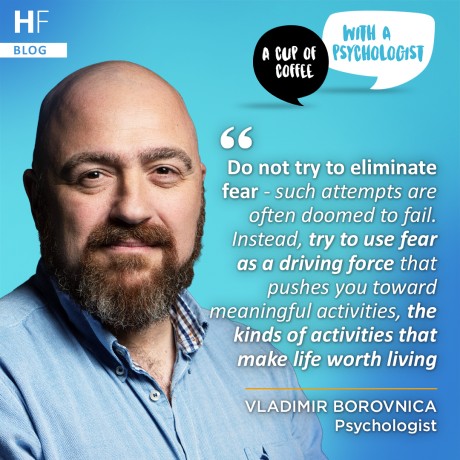
A final message: do not try to eliminate fear. That is often doomed to fail. Instead, try to use fear as a driving force that pushes you toward meaningful activities, the ones that make life worth living.
AUTHOR
Vladimir Borovnica
Psychologist