
22/04/2026
Reading as a Choice in the Age of Algorithms
Slobodan Brkić
Economist and DJ
Reading as a Choice in the Age of Algorithms
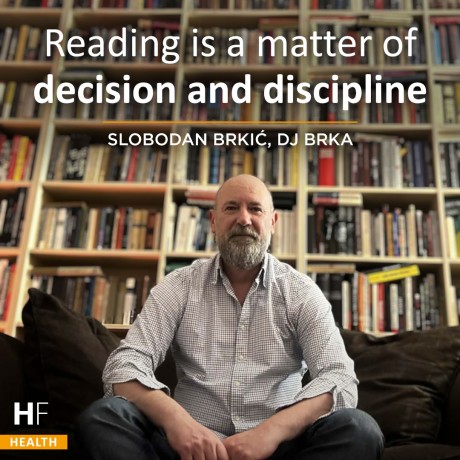
Reading is a matter of decision and discipline, but over time it evolves into a necessity, a way of life. It becomes a need to better understand the world and to live, at least to some extent, beyond the reach of the algorithms, topics, and content imposed on us by the internet, the media, and the entertainment industry.
My approach to reading is simple. I choose books carefully and read for at least an hour every day. I prefer print, but I have no resistance to e-books, which allow me access to the latest global releases. I aim to read one book per week and follow this monthly structure.
In the first week, I read contemporary fiction, either international or domestic, including novels or short stories. In the second week, I focus on professional literature, essays, or what is broadly referred to as nonfiction, such as biographies, philosophy, economics, history, politics, and psychology. The third week is reserved for a classic, domestic, or international, which helps fill the gaps in general knowledge. In the fourth week, I turn to books related to music and popular culture.
Of course, things do not always go according to plan, and the structure occasionally falls apart, but what matters is the intention and the awareness that a plan exists. There have been years when I read more than fifty books, and others when that number was significantly lower. Still, one thing is certain. The older I get, the more I read, and the better I read.
The math is simple. Anyone can set aside twenty to thirty minutes a day for reading, whether on public transport or before bed, and over the course of a year finish around twenty-five books of roughly 300 pages. That alone places you in the top 1% of readers in Serbia, the so-called super readers. A telling fact is that nearly two-thirds of the population in Serbia does not read a single book per year, year after year.
I would recommend two autobiographical novels by authors from our region, both close to me generationally. The first is 1983: Fictional Maneuvers by Miljenko Jergović, and the second is Free: Coming of Age at the End of History by Lea Ipi. Jergović is likely already familiar to you, while Lea Ipi, a professor at the London School of Economics originally from Albania, made a remarkable entry into literature with this book and achieved significant international success.
Jergović presents his personal history through events that marked 1983 in Sarajevo and Yugoslavia, while Ipi recounts her childhood in Durrës during Albania’s transition from totalitarian communism to chaotic capitalism. Both books explore life, more precisely the process of growing up in times of profound upheaval. Although Yugoslavia and Albania were vastly different countries at the time, in 1983 isolated Albania was at the peak of totalitarianism, while cosmopolitan Sarajevo was preparing for the Olympic Games, their fate was ultimately the same. Both Tito’s Yugoslavia and Hoxha’s Albania were destined to collapse.
For the young protagonists of both books, Lea, a model pioneer, and Miljenko, a melancholic punk, that outcome, despite all the signs, seemed impossible at the time. With the fall of the old system and the arrival of the new, many questions emerge. What did we gain, what did we lose, when was it better? Or perhaps all of us who lived through those years remain, in some way, trapped in that enduring past, whose interpretations only multiply as time goes on.
AUTHOR
Slobodan Brkić
Economist and DJ