
22/06/2026
Leisure Time - An Ally of Mental Health
Ivana Stepanović Ilić
Leisure Time - An Ally of Mental Health
Author: Prof. Dr Ivana Stepanović Ilić, Department of Psychology, Faculty of Philosophy, University of Belgrade
When we talk about mental health, we most often think of rest, physical activity, or psychological support. However, a growing body of scientific research shows that art, music, books, films, and sport play a significant role in preserving psychological well-being. What we often perceive as recreation — and sometimes even as a waste of valuable time — is, in fact, a set of important everyday rituals that contribute to a better mood, reduce stress, and strengthen our sense of connection with others.
In relation to the activities with which we fill our leisure time, researchers distinguish between structured and unstructured leisure. Structured leisure is often referred to as serious leisure, highlighting long-term engagement and commitment, such as playing a musical instrument or attending a ceramics course. It contributes to the development of various knowledge and skills, as well as to a person’s identity.
On the other hand, unstructured or relaxed leisure includes activities that provide immediate pleasure and relaxation, such as listening to music, reading, watching a film, attending cultural events, or going to sports matches. Although structured activities are often given priority because of their long-term contribution to skill development and identity formation, research shows that unstructured leisure is also highly important for mental health. When we experience unstructured activities as a space for personal choice, enjoyment, and fulfilment, they contribute to stress reduction, better emotion regulation, and greater life satisfaction. Relaxed leisure time is the “other side of the scale”, helping to establish a healthy balance and serving as a counterweight to the demands of often highly stressful everyday life.
Reading is much more than an important resource that enriches knowledge and increases the chances of academic achievement. Studies show that this habit is associated with reduced feelings of loneliness and depressive symptoms, as well as with better coping with stress.
Listening to music has numerous psychological functions that contribute to personality development during adolescence, as well as to maintaining good mental health later in life. Music is often an integral part of our identity and an element that connects us with others. It improves quality of life by contributing to emotion regulation and stress management.
Regular visits to theatres, museums, galleries, and concerts are associated with a significantly lower risk of developing depression and other mental disorders, as well as with a stronger sense of well-being. Films and series can make us laugh, move us emotionally, or encourage conversation. Watching them together and exchanging impressions with family and friends contributes to a sense of connection and life satisfaction. Through stories on screen, we often recognise our own experiences and emotions, which can help us understand them better.
Research findings indicate that following sporting events is associated with higher life satisfaction, positive emotions, and a sense of vitality. Identification with sports teams contributes to a sense of belonging and identity development, and is also often a source of social support, which is an important factor in psychological well-being. In light of the ongoing FIFA World Cup, perhaps we should reconsider the well-known saying that football is “the most important secondary thing in the world”. The problem is not with the word “important”, but with the word “secondary”.
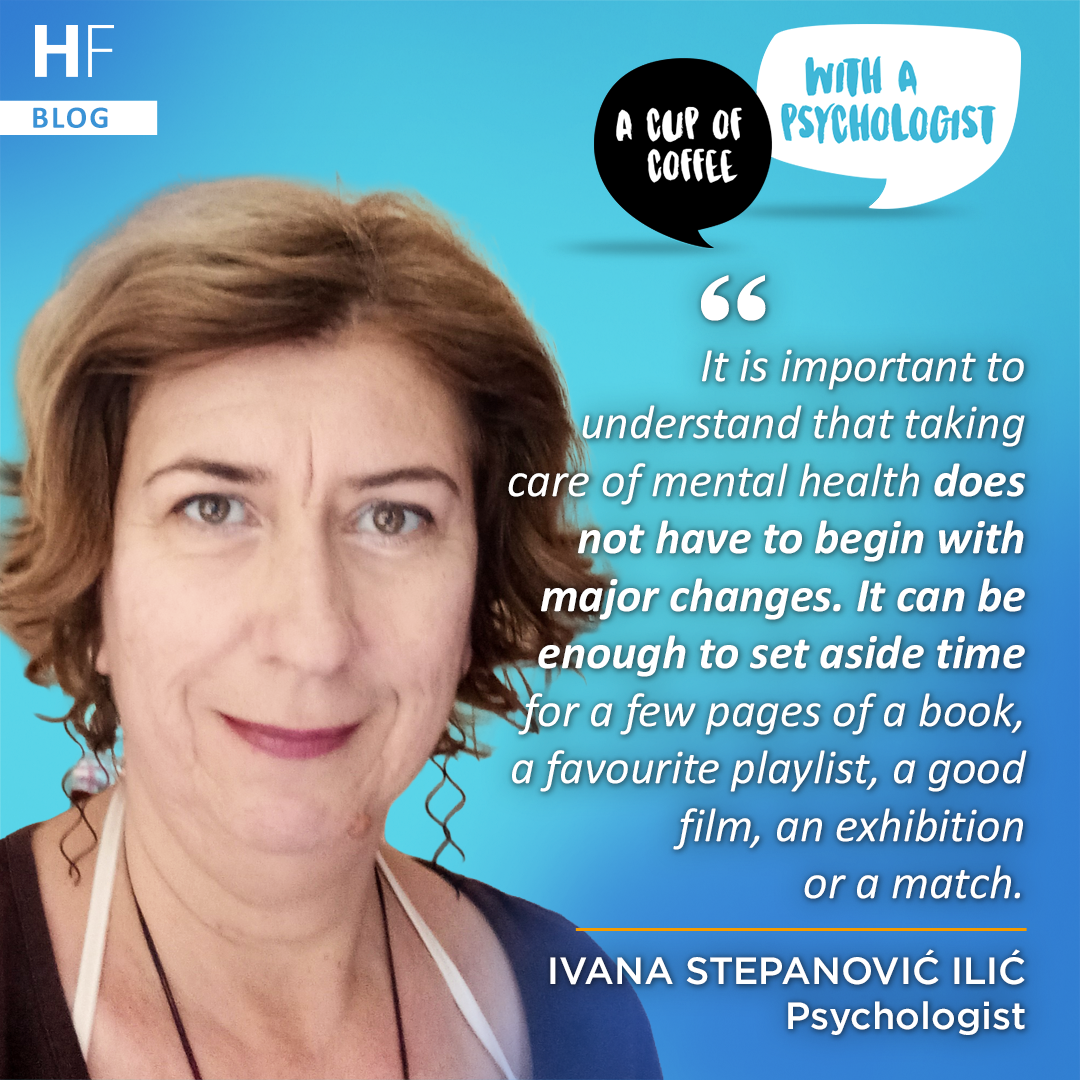
Taking all of this into account, it is important to understand that caring for mental health does not have to begin with major changes. It is enough to set aside time for a few pages of a book, a favourite playlist, a good film, an exhibition, or a match. These small rituals are not merely pleasant ways to spend our leisure time; they also help us better understand ourselves, regulate our emotions, and find a sense of meaning and connection with others.
AUTHOR
Ivana Stepanović Ilić