IN SOLIDARITY
At our core, human beings are social creatures. Even today, we come into this world through the social interaction of at least two people.
Yet for nearly a century, modern society has employed various mechanisms that leave individuals feeling anxious or, more simply put, lonely. From psychoanalysis to humanistic and existential psychology, the search for freedom and meaning has become central to our understanding of the human condition.
Rollo May, one of the leading figures in existential psychotherapy, like Viktor Frankl, explored the fundamental purpose of human life. For May, that purpose lies in striving to live freely, authentically, and responsibly at every moment. One of the rare blessings of living with anxiety is that it forces us to become aware of ourselves. Even under the unimaginable conditions of concentration camps, people managed to survive by searching for meaning in their existence.
When an individual's existence is reduced to mere survival, or when people living under totalitarian regimes are stripped of their rights and reduced to an indistinguishable mass, their locus of control shifts beyond themselves.
This sense of helplessness is a particularly dangerous form of dehumanization because, as our own experience demonstrates, it can persist for decades. Everyday life comes to be perceived as uncertain and threatening, resulting in apathy and a profound sense of powerlessness.
The political changes Serbia has experienced over the past few years, culminating in the Student List's electoral victory, have brought something far more significant than election results alone.
First came hope, followed closely by empathy, which we might also call solidarity.
Just two years ago, at a gathering of psychotherapists in Belgrade, one of the central topics was the lack of empathy, both among individuals and across society.
Fortunately, in an astonishingly short period, many of us have witnessed, sometimes smiling, sometimes moved to tears, remarkable expressions of empathy and solidarity at every level.
Grandparents welcoming students with apples or homemade cakes, embracing them as though they were their own grandchildren. People from different ethnic backgrounds united by a common purpose. Parents and children, neighbors organizing through local citizens' assemblies, and students participating in their own plenary meetings.
This form of direct democracy, or horizontal decision-making, emerged spontaneously in response to decades of distrust toward political organizations in Serbia.
The absence of hierarchy requires people to communicate as equals, person to person, without the dynamics of subject and Leader, elder and younger, Parent and Child, or all-knowing therapist and helpless client.
Empathy and solidarity represent a fundamental bond between free individuals. They go beyond tolerance, which merely asks us to accept differences.
Tolerance, unfortunately, is only the first step toward solidarity and empathy. Both require us to move beyond the egocentrism that shapes our thoughts, emotions, and social relationships.
Solidarity demands more than accepting others. It requires a genuine desire to understand their actions, feelings, and ideas.
In the consumer society we inhabit, solidarity is fundamentally counterproductive. From a purely economic perspective, it represents a net cost.
You give without receiving anything in return, whether through charity, donations, volunteering, or simply offering your time to help others solve their problems rather than your own.
Solidarity does not pay, unless you are unscrupulous enough to turn your generosity into an exercise in self-promotion. In that case, society may celebrate you as a patron, humanitarian, philanthropist, or benefactor of the poor.
But solidarity must stand for something infinitely more meaningful than an attempt to cleanse the guilty conscience of a society shaped by economic transition.
It is a value cultivated through family upbringing. It should be an integral part of education, and it deserves consistent visibility and encouragement in the media, everywhere and at all times.
Solidarity must be firmly established as a value that a society consciously chooses to uphold, promote, and develop.
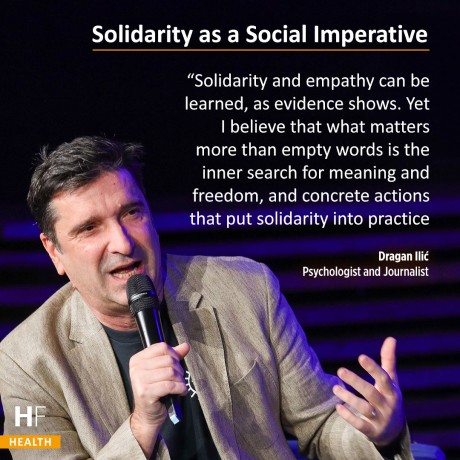
We know that solidarity and empathy can be learned. Yet I believe that, rather than empty words, what truly matters is an inner search for meaning and freedom, accompanied by concrete actions that bring solidarity to life.
In Serbia, solidarity has traditionally emerged most visibly during times of crisis: NATO bombing, floods, displacement, or collective traumatic experiences such as the murders at Ribnikar school or the collapse of the railway station canopy in Novi Sad.
Tragedy brings people closer together, reflecting what might be described as an almost instinctive need for human connection.
However, the responsibility of psychotherapy, the education system, families, and the media must be to nurture solidarity in everyday life, as an alternative to the –‘getting by’ mentality in the transitional period.
Finally, a practical piece of advice.
In Serbia today, amid the euphoria of victory, it is easy to recognize the so-called ‘Ćaci’, whose power is disappearing like a soap bubble.
Yet in this tragicomic situation, it is especially important to identify and confront the only ‘Ćaci’ we can truly change.
That is the ‘Ćaci’ lurking within each of us, regardless of our political beliefs.
Decades of populism, hatred, and aggression in public discourse have undoubtedly left their mark on all of us. We urgently need to confront the ‘Ćaci’ within ourselves.
This reminds me of an artist I once encountered in a gallery in Timișoara, who was selling small sculptures of the dictator Nicolae Ceaușescu.
About a dozen of these figurines were scattered across the gallery floor. The artist told me that there were as many such figures as there were Romanian men and women, because a little Ceaușescu lurked inside every one of them.
By the same logic, perhaps a little ‘Ćaci’ lives within each of us.
We simply need to recognize it.
Together. In solidarity.
AUTHOR
Dragan Ilić
Psychologist and Journalist