What Remains After Loss?
Loss is one of the most difficult experiences in life. Regardless of our individual differences, social status, or cultural background, we tend to respond to loss in similar ways. Loss is also most often a fully or partially irreversible experience. When it involves the loss of a loved one, it is irreparable. What remains is the possibility for that relationship and the experience of the other person to become part of our inner world. Yet it is hardly enough, and the process of accepting loss is long, sometimes lifelong.
In psychotherapy, when we speak about loss, we most often think of the death of a loved one. Grief following loss is a natural and universal human experience. Mourning is a normal response and should not be “treated” or pathologized. From a diagnostic perspective, grief is an adaptive response, although it can sometimes be associated with major depressive episodes, PTSD, or generalized anxiety disorder. According to the World Health Organization, the most stressful life event, regardless of ethnicity, country, religion, or social status, is the loss of a loved one. While there are many attempts to describe grief in stages, each grieving process remains deeply individual.
Grief is the gradual acceptance of an irreversible reality in which the object of love is no longer present. However, despite the fact that it is universal and natural thing, many people do not fully enter the grieving process, instead relying on defense mechanisms to avoid confronting loss.
Responses to loss vary depending on the nature of the relationship, as well as personal and contextual factors such as beliefs, cultural frameworks, and perceived social support. Whether the loss was expected or sudden also plays a significant role.
Grief is both a natural reaction and a transition. It transforms our understanding of the past and of our relationship with the person who has died. The relationship, as it existed externally, is over; unresolved aspects can no longer be changed. The survivor is left to revisit and reinterpret the relationship internally. Many people describe a sense of discontinuity,they speak of a time before and after the critical event, as if there were an unbridgeable gap between the two.They often feel isolated in their grief, as though no one else can fully understand it. Deep sorrow can create an invisible barrier between us and the world.
Grieving should never be seen as weakness, but as a psychologically significant process. Yet many people feel pressure to return to “normal” functioning as quickly as possible. In reality, loss carries transformative potential, and life after loss cannot be the same. In a society focused on efficiency and speed, we are expected to “recover” quickly, even from profound suffering. At the same time, modern urban life often disconnects us from rituals that traditionally support mourning—rituals that provide collective structure and meaning. Without them, people may feel disoriented, isolated, and even stigmatized.
The experience of loss is not limited to death. We may feel loss when an important relationship ends or is threatened. Even functional or necessary separations can trigger strong grief responses. Different life stages, especially midlife transitions, can also bring a deep sense of loss—of youth, vitality, and possibility. Confronting life’s transience also means confronting our own mortality. While this awareness can evoke fear and discomfort, it can also give rise to meaning.
Loss is not only an individual experience. As a community, we have experienced the loss of parts of our collective identity. As a society, we are deeply affected by the losses we witness and share. Change itself—bringing something new—can be experienced as loss, while nostalgia reflects longing for what has passed.
Emerging from grief is one of the most complex processes a person can go through. It is not linear but resembles a labyrinth, often leading us back to places we thought we had already left behind. Some people remain “stuck” between denial and grief, preventing true integration.
Who among us, no matter how competent or self-aware, is spared the experience of loss?
In fact, life’s most complex experiences are almost always tied to some form of loss. Development itself is inseparable from loss: whenever something new begins, something old changes or disappears. These transitions can feel deeply dramatic, with intense reactions and uncertain recovery. We may remain for a long time in that in-between space, unable to see a way forward.
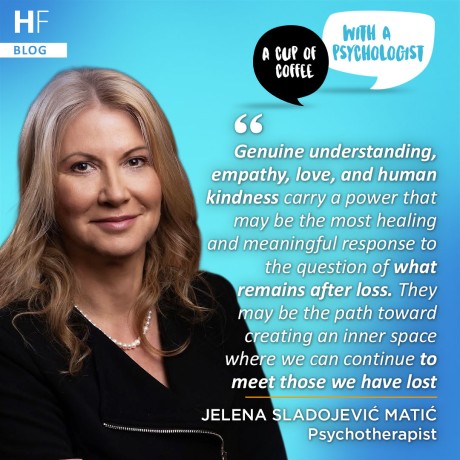
Genuine understanding, empathy, love, and human kindness carry a power that may be the most healing and meaningful response to the question of what remains after loss. They may be the path toward creating an inner space where we can continue to meet those we have lost.
If we are able to accept transience and understand that people, relationships, and even parts of ourselves can never return in the same form, we open the possibility of continuing a relationship with them in a different way.
The story of loss is always also a story of love—love for others, for ourselves, and for the parts of life we have lived and that have passed. Love is the essence of deep connection. The experience of loss, and the confrontation with mortality it brings, are among the greatest sources of human suffering. Helping another person through such suffering is an act of profound love. Psychotherapists face an important task here: how to awaken and sustain hope in people who suffer in this way?, How can they reassure and steady themselves so they can help others?.
“When we finally realize that we will die, and that all other sentient beings will also die, we begin to feel an intense, almost unbearable sense of the fragility and preciousness of every moment and every being. From this can grow a boundless compassion for all,” said Sogyal Rinpoche.
The story of love is inseparable from the story of loss. If we are able to be truly present in our lives and in the lives of those we love, grateful for both what we have and what has passed, and aware that at least parts of our lives are meaningful, then perhaps we can embrace life and all that makes it worth living.
We are also everything we have lost. Those people, relationships, and experiences may no longer exist outside of us, but they remain within us—as inner companions we return to, connect with, and continue to love.
The love of others, love for ourselves, and love for the work we do help us endure the experience of loss.
AUTHOR
Jelena Sladojević Matić
Psychotherapist