
06/05/2026
Youth and Depression
Vesna Brzev-Ćurčić
specialist in medical psychology, training psychoanalyst PSS
Youth and Depression
Depressed mood is one of the essential characteristics of adolescence. It is conditioned by physical and mental changes that cause emotional fluctuations and mood swings. The way of adaptation depends on the previous development of the personality, defence mechanisms, capacity for tolerance of changes, family functionality, overall environment.
Depressed mood generally does not have the characteristics of adult depression or clinical depression and is sometimes difficult to recognize. Adolescents are particularly vulnerable to these conditions and possess a range of manoeuvres to defend, protect, or mask the state they are in. For adults, it is especially difficult to recognize these conditions and they mostly interpret it in the wrong way. That is why adolescents are often attributed various traits that are actually just a skilfully hidden depressive tone.
Extremes in which depressed mood manifests can further frighten, first of all, parents, and then the environment. They can also scare adolescents themselves, who are not yet cognitively or emotionally able to comprehend the dynamics of growing up, extremely unpredictable mood swings, whirlwinds of emotions, from elation to despair. Sometimes they resort to behaviours involving various forms of substance misuse, even though they are not addicts.
The degree of suffering from the changes brought about by the adolescent period also determines the way of coping with them. Sometimes it exceeds the capacity of the adolescents to mentalize their feelings, sometimes the feelings are "played out" instead of elaborated, sometimes repressed as if they never existed.
Any fluctuations in the mood of an adolescent are difficult for parents to accept, because a relatively stable child grows into an unpredictable person. Unpredictability, like everything that is unknown, scares and angers parents, who often cannot keep up with the breakneck speeds at which their adolescent's mood changes. This leads to conflict and misunderstanding on both sides. Parents interpret these upheavals as a kind of whim, lack of cooperation, or sometimes even disobedience, while adolescents see them as a lack of understanding and acceptance of their fragile personalities on the part of their parents. In this conflict, professional help is sometimes necessary for both the adolescent and his parents. Often, this misunderstanding between the two sides, seemingly opposed, but equally afraid of change, is transferred to the school, which does not have a larger arsenal of methods for coping with this period.
However, a depressive mood tone also has creative potential because there is never a more creative and inspiring period in life than adolescence. Numerous manuscripts, music, thoughts, artistic creations, are created precisely as a response to a depressive mood. After all, without this quality of mood, there is no growing up, or at least that creative growing up that is later slowly, except in rare cases, lost.
Depression is sometimes a trigger for rebellion, the change necessary for the progress and development of any society. It's not aggressive, or destructive, but it has a creative quality that adults sometimes don't recognize.
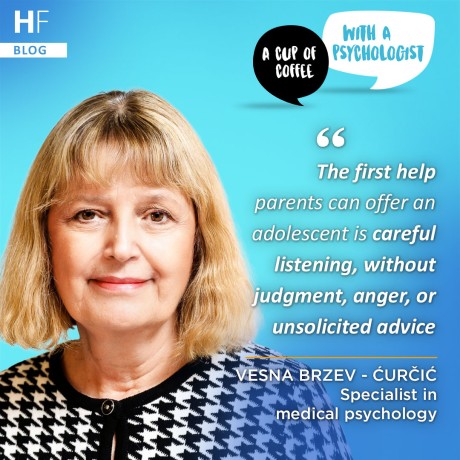
The first aid that parents can provide to an adolescent who is in this state is to listen carefully, without commenting, getting angry, sharing advice that is not requested. This is how the unique language of their adolescent is learned, and this paves the way for mutual understanding. It requires patience and tolerance of both parties, or rather, all parties involved in the development.
And finally, there are experts, psychotherapists who know the dynamics of adolescent development, who do not treat such conditions as pathological, but direct them towards easier understanding, tolerance and finding a more mature path to adulthood.
AUTHOR
Vesna Brzev-Ćurčić
specialist in medical psychology, training psychoanalyst PSS