Transplantation Is Life. Hemodialysis Is Survival
My struggle with kidney disease began in childhood. As a little girl, I was diagnosed with bilateral VUR (vesicoureteral reflux), and at just eleven years old, I underwent my first surgery. Back then, I had no idea that this illness would follow me like a shadow for the rest of my life.
Then, in 1998, during my second pregnancy, everything suddenly started to go wrong. I was 22 years old and 20 weeks pregnant when my creatinine and urea levels suddenly rose dramatically. The doctors told me the pregnancy was extremely high-risk. I was overwhelmed with fear, but I carried the pregnancy through and gave birth to my son at 36 weeks, a month early. Thank God, he was healthy. At that moment, that was the only thing that mattered to me.
After I gave birth, my test results stabilized, and for years I went for regular check-ups at the Clinical Center. I lived a normal life until 2004, when everything changed completely. One day, I slipped into a mild coma. That was when the doctors discovered that my creatinine was over 800 and my urea was 60. There was no more waiting, no more postponing, no more choice. I had to begin hemodialysis immediately.
During that time, I met Dr. Radmila Blagojević, who suggested transplantation. She told me that my parents could be potential donors. Both my mother and father went through the necessary testing, but it turned out that my mother was a better match. And so, my mother donated her kidney to me.
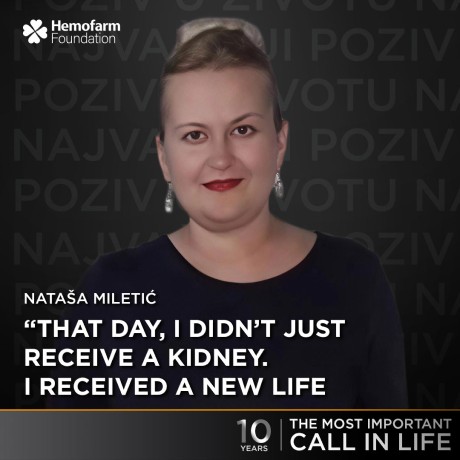
I had my transplant on May 11, 2004. That day, I did not just receive an organ. I got my life back.
With my transplanted kidney, I lived like a completely healthy person. Yes, I had my therapy, and yes, I took my medication regularly, but I was able to live normally, to be a mother, and to watch my children grow. When I had my transplant, my daughter was eight and my son was five years old. I was blessed to be there for them during their childhood, not just watching from the sidelines, but truly taking part in their lives.
For ten full years, the kidney worked without any problems. And then, in 2014, my test results suddenly began to worsen, and it turned out that my underlying disease had returned. Since October 24, 2014, I have been on hemodialysis.
That was an enormous shock. For the first time, I found myself connected to the machine. For the first time, I truly understood what it means to live on dialysis. People often think dialysis is just a few hours spent attached to a machine. But it’s far more than that.
Three times a week — on Mondays, Wednesdays, and Fridays — I go to dialysis. Those three days are almost erased from my life, because after dialysis come weakness, nausea, exhaustion, and drops in blood pressure. Your whole body hurts, but you still have to keep going. That is why I often say that I do not have seven days a week to live. I only have four.
Transplantation is life. Hemodialysis is survival.
And still, I am not someone who lies down and surrender. I am a fighter. I fight for my children, for my family, and for the people I love. After every dialysis session, I try to get up, go for a walk, do something, give myself a reason to keep moving forward.
Dialysis did save my life. But it also changed it beyond recognition. You begin to plan everything around treatment—your work, your travel, your responsibilities, even an ordinary day. And yet, somewhere along the way, you learn to treasure the little things. One walk. One good day. One phone call from a friend. You learn, in the hardest possible way, what health is worth.
I have been on the transplant waiting list for three years now. To this day, no call has been made to me. I had complications with my parathyroid gland, which meant that for a while I could not even be on the list. Once that was resolved, I was finally placed on the list, and now I wait. The doctors tell me that I have a specific blood type and antibodies, which makes it harder to find a matching organ.
But I still believe the call will come.
Whenever the phone rings and I see an unknown number, I think, Maybe this is it. Maybe this is the kidney. And then I tell myself — it will happen. One day, it will happen.
The greatest strength comes from my family and from the people who are walking this same road. Dialysis patients understand that struggle better than anyone else — the exhaustion, the waiting, the life suspended somewhere between hope and fear. We often say that we are humane, that we are compassionate, that we care for one another. But when the moment comes to say one simple ‘YES,’ many people hesitate.
And yet, one ‘YES’ can save as many as eight lives.
Behind every number on a waiting list is a person. Someone’s mother. Someone’s father. Someone’s child. Someone’s whole world.
That is why I believe we must speak more openly about transplantation and organ donation. We must raise awareness. We must be the voice of those who are waiting.
Because transplantation does not just prolong life. It gives life back.
AUTHOR
Nataša Miletić